Skip to content


The safest way to protect your show over summer is to batch record podcast episodes while everyone is still at their desks, yet most Perth businesses leave it until the diary has already closed. By the second week of December, guests stop replying, the team is winding down, and the studio calendar is full.
So the show quietly stops. In practice, a January restart takes far longer than anyone plans for, because the habit is broken and the backlog of decisions has to be made all over again.
The fix is to batch record podcast episodes on one planned production day, rather than treating the whole thing as a December panic. Here is how to think about it properly.
Why You Should Batch Record Podcast Episodes Before the Break
The reason to batch record podcast episodes before summer is simple: the Western Australian shutdown is long. Between mid December and the end of January, guests travel, offices close, and your usual recording rhythm disappears for six weeks or more.
Publishing, however, does not need to stop. A bank of finished episodes means your show keeps appearing on schedule while nobody is actually recording, which is exactly when a quieter feed gives you more attention rather than less.
There is a second benefit that matters just as much. Because you record several episodes in one booked session, the total time you spend travelling, setting up and warming up drops sharply. A little strategy and planning in October turns three separate half days into one productive one.
What Does It Mean to Batch Record Podcast Episodes?
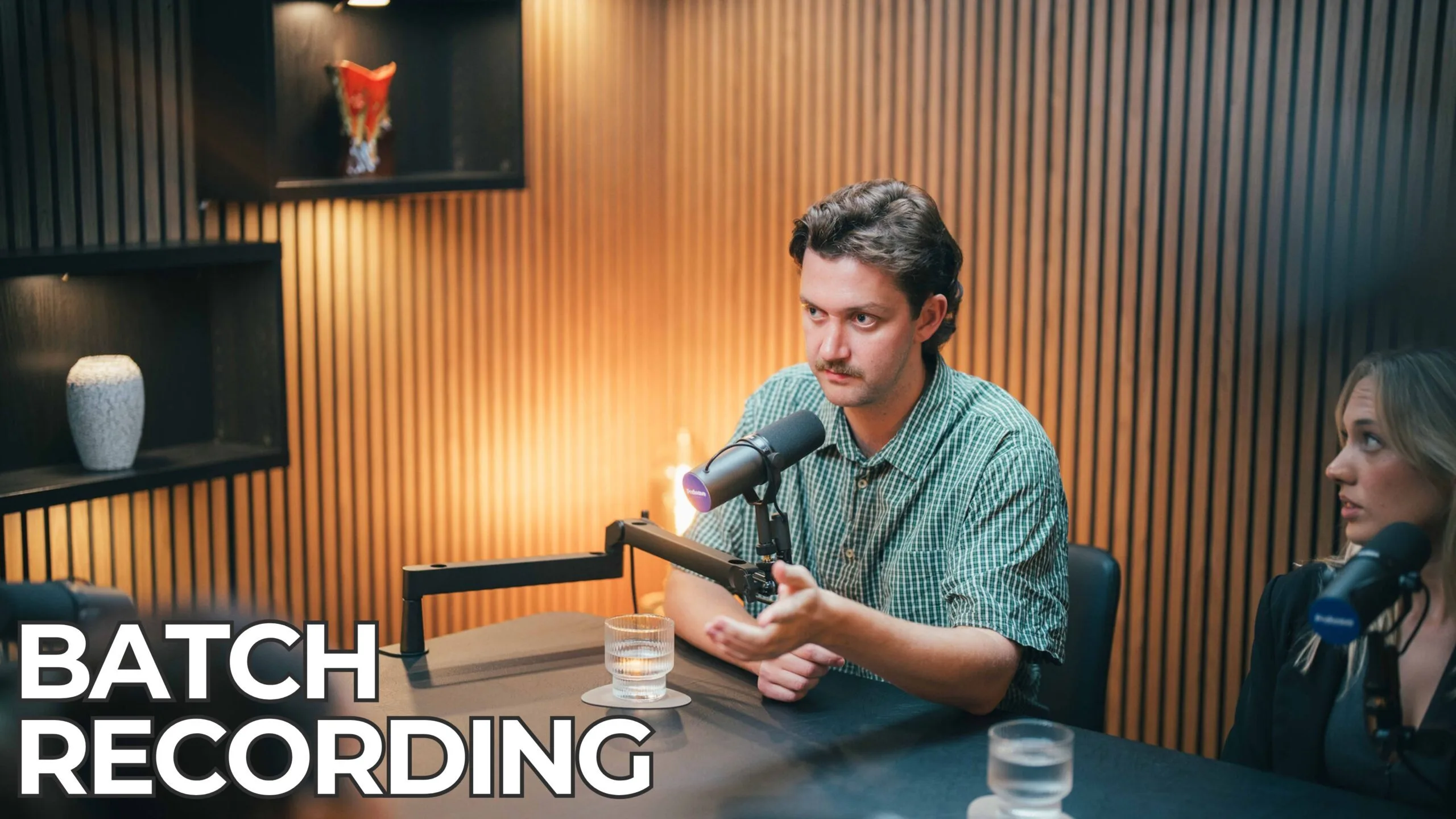
To batch record podcast episodes is to record several complete episodes back to back in a single studio session, usually three to six, then edit and release them one at a time across the following weeks. The recording work is compressed, whereas the publishing schedule stays exactly as it was.
Notably, nothing about the episodes themselves changes. Each one is still a full conversation with its own topic, intro and ending, and a listener should never be able to tell which episodes shared a day.
What does change is where the work sits in your calendar. Instead of one recording every fortnight, you have a single day in the studio and a run of edits afterwards, which our editing services team can turn around while you get on with the end of the year.
How Many Episodes Can You Record in One Session?
Most business hosts comfortably record three to four episodes in a half day and five to six in a full day, allowing roughly forty-five minutes of recording and fifteen minutes of reset for each one. Beyond six, quality almost always drops.
Solo and co-hosted formats move fastest, since there is nobody new to settle in. Interview episodes take longer, because each guest needs a greeting, a sound check and a few minutes of warm up before the camera rolls.
Energy is the real limit. By comparison with episode one, episode seven is slower, flatter and harder to edit, and the difference is obvious on video. So book the session you can actually sustain when you batch record podcast episodes, and check what a full day of studio hire gives you before deciding how many to attempt.
How to Batch Record Podcast Episodes Without Sounding Rushed
The risk with any batch is sameness. Five episodes recorded in one sitting can look and sound identical, which tells your audience they were filmed months ago. Fortunately, a handful of small habits remove that problem entirely:
- Change your shirt between episodes. Viewers notice when five videos share one outfit, and a jacket swap or a second shirt is enough to break it up.
- Keep the language evergreen. Avoid references to this week, the weather or a news story, since an episode recorded in November may not publish until February.
- Reset properly between takes. Ten minutes, water, and time on your feet means episode four still has the energy of episode one.
- Record your intros last. Once you know how each conversation actually went, the introduction almost writes itself and lands far better.
Above all, treat each episode as its own recording rather than the next item on a list. A short pause and a deliberate restart is what separates a batch from a marathon.
What to Prepare Before the Studio Day
Preparation is where a batch either works or falls apart, because once you batch record podcast episodes you cannot stop mid session to decide what episode four is about.
First, lock your topics in advance and write a one line brief for each, which is far easier if you already have a system for generating episode ideas. Second, stagger your guests so each arrives about thirty minutes before their slot rather than all at once. Third, print or load the running order, so the room always knows which episode is next.
Finally, decide the publishing dates before you record. Knowing that these six episodes cover December, January and the first week of February gives the day a clear purpose, and it tells your editor exactly when each one is needed.
What Does Not Work
Cramming eight or nine episodes into one day does not work when you batch record podcast episodes. Fatigue reads on camera long before the host feels it, and the last few episodes usually get shelved anyway, so the extra hours buy you nothing.
Dated references do not work either. A single mention of a current event, a sporting result or the school holidays locks that episode to a week, which defeats the entire point of recording ahead.
Leaving the edit until January does not work at all. Brief your editor in the same week you record, because a finished episode sitting unedited over summer is the same as no episode. Schedule the releases and the supporting clips while the material is fresh, since both YouTube and Spotify allow you to queue uploads ahead of time, and your promotion can run to the same calendar.
[IMAGE 2 GOES HERE]
When Should You Batch Record Podcast Episodes for Summer?
Book your session for October or early November, and record enough episodes to cover every publishing week from mid December to the start of February. Guest availability collapses through late November, therefore the earlier booking is almost always the easier one to fill.
Count backwards to work out the number. Six weeks of weekly episodes means six recordings, whereas a fortnightly show needs only three, and most Perth businesses land somewhere between the two.
If the studio is already busy when you call, take the half day and record three strong episodes rather than waiting for a perfect full day booking. In short, three finished episodes in November beat six imagined ones in December.
Frequently Asked Questions
How many podcast episodes should you batch record before Christmas?
Most business shows need between four and eight episodes to cover mid December through to early February, which is roughly one full day in the studio. Count the publishing weeks you want to protect, then record one episode for each.
Do batch recorded podcast episodes sound out of date when they publish?
They do not, provided the conversations avoid references to current news, the weather or the date, because an evergreen episode is just as relevant two months after it was recorded. Anything genuinely time sensitive should be recorded closer to its release instead.
How long does a batch recording session take?
A full day session of five to six episodes usually runs six to seven hours including setup, resets and breaks, while a half day of three episodes takes around four hours. Allow extra time when a different guest is arriving for each episode.
Ready to Bank Your Summer Episodes?
At Podwave Studios we run full day and half day recording sessions built for batching, with studios in West Leederville and West Perth, a producer in the room and an editing team that can have your December and January episodes finished before the break. If you would rather publish through summer than restart in February, book a studio and we will plan the day with you.