Skip to content


Podcast studio hire is often treated as the expensive option, and building your own setup as the sensible long-term investment. For most Perth businesses that is backwards.
The maths looks obvious on paper. Buy the gear once, record whenever you like, never pay a session fee again. However, what that calculation leaves out is the room, the time, and the person who has to run it.
Here is what each option actually costs, and how to work out which one fits your show.
What Podcast Studio Hire Actually Includes
The session fee is the visible part. What you are paying for underneath it is a room that has already solved the hard problems.
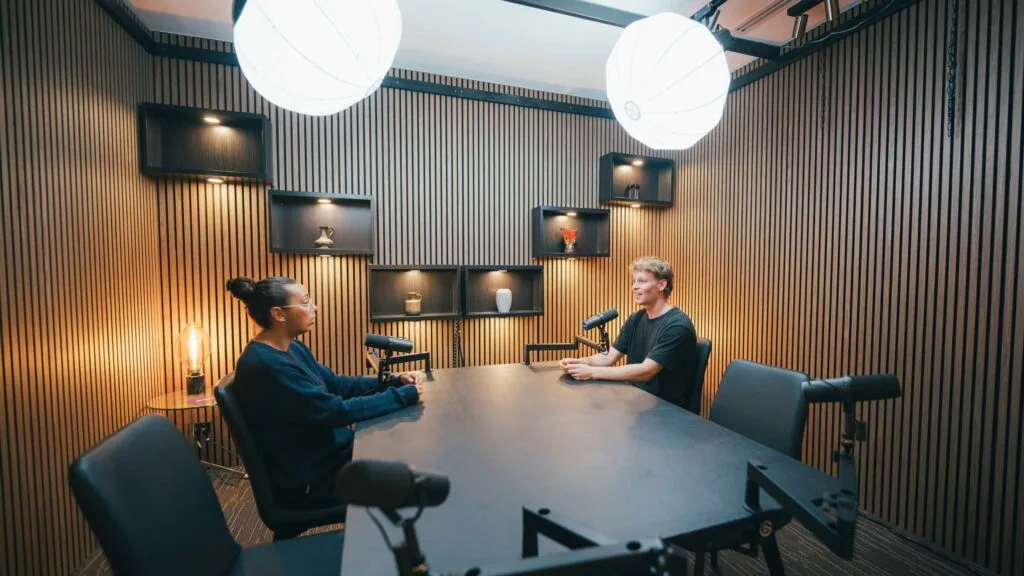
A purpose-built space gives you acoustic treatment, so the recording does not sound like a meeting room. It gives you lighting that is already set for the cameras. It gives you microphones matched to the space, cameras framed for both the full episode and vertical clips, and a producer who has run hundreds of these sessions and can tell when something is not working while there is still time to fix it.
In short, the value is not the equipment. It is that none of it is your problem. You arrive, you record, you leave, and the files go to an editor. For a business owner whose time is the scarcest resource in the company, that is usually the entire argument.
The Real Cost of Building Your Own Setup
In practice, businesses that price up an in-house setup cost the equipment and stop there. The equipment is the cheapest part.
The room, however, is the expensive part. An untreated office produces reflections that no microphone choice fixes and no editor fully repairs. Treating a room properly means either dedicating a space you currently use for something else, or accepting recordings that sound like they were made in an office, because they were.
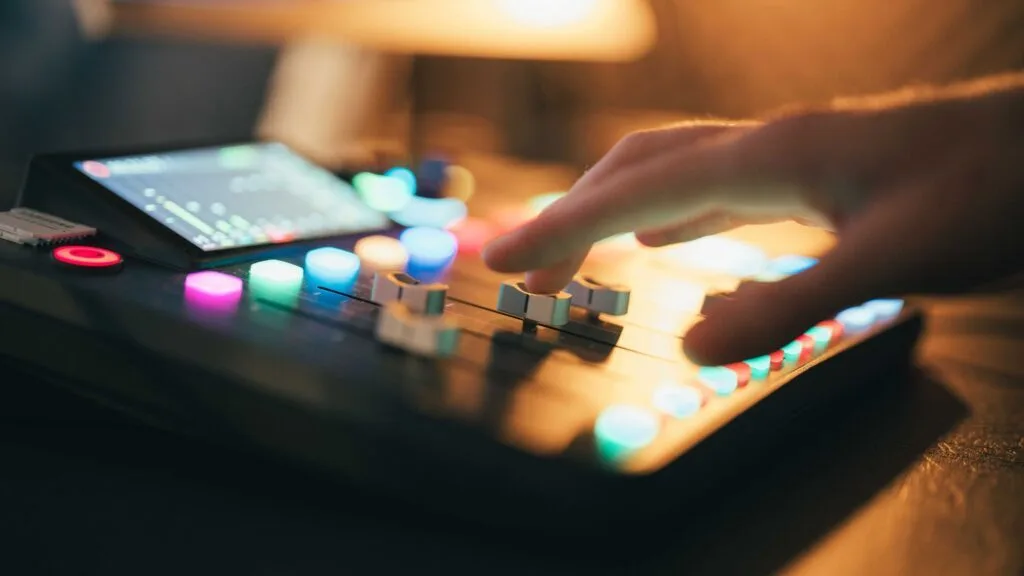
Then there is the operator. Someone has to set up, check levels, monitor the recording, pack down, and troubleshoot when a camera stops writing to the card mid-episode. If that person is you, the real cost of your own setup is an hour either side of every recording, forever. If it is a staff member, it is a portion of their salary.
Finally, there is obsolescence. Cameras and capture equipment date quickly. A studio absorbs that cost. You do not.
When Podcast Studio Hire Makes Sense
Podcast studio hire is the right call in most of these situations:
- You publish fortnightly or monthly. At that cadence, session fees stay well below the cost of building and maintaining a room.
- You want video. Multi-camera video is where the gap between a studio and a DIY setup is most obvious to a viewer, and the platforms have made video central to how shows are published.
- Your guests are clients or prospects. The recording environment is part of the impression you make. Inviting a prospective client into a professional studio says something different to setting up a tripod in your boardroom.
- You do not want to become a producer. Most business podcasts fail from workflow fatigue, not lack of ideas.
- You are still testing the format. Committing to a room and a rig before you know whether the show will survive twelve episodes is the most common way to waste money on podcasting.
When Your Own Setup Is the Better Call
There are genuine cases for building in-house.
First, high frequency. A daily or twice-weekly show changes the arithmetic quickly, and at that volume the convenience of recording whenever you like starts to outweigh everything else.
Second, audio-only formats. A solo commentary show recorded on a good microphone in a treated corner of an office is a legitimate setup, and the bar is much lower than it is for video.
Third, a business that already has the space, the equipment, and a person whose job includes running it. If you have an in-house content team, you are not really choosing between the two options. You are choosing when to bring in a studio for the episodes that need to look better than usual.
The Cost Most Businesses Miss
Notably, the hidden cost of an in-house setup is not money. It is the friction that stops episodes being made.
Every step between deciding to record and actually recording is a place where a busy week can derail the schedule. Setting up gear is such a step. Booking a studio is also a step, but it is a commitment in the calendar with someone else expecting you, which is a very different psychological object to a box of equipment in a cupboard.
In practice, shows die from inconsistency far more often than from production quality. Therefore, whichever option removes the most friction from your specific week is usually the right one.
Podcast Studio Hire in Perth: What to Look For
Not all podcast studio hire is the same, and the differences matter more than the hourly rate.
Start by asking what the room was built for. A photography studio with microphones added is not a podcast studio, because acoustic treatment is the one thing you cannot retrofit on the day.
Next, find out how many cameras are running and whether the framing supports vertical clips. If clips are part of your distribution plan, and for most Perth businesses they should be, then the framing decision is made at the recording rather than in the edit.
Then consider who is actually in the room. A session with a producer running it is a very different experience to being handed a key and left to it.
Also establish what happens to the files. A studio that hands over raw footage leaves you with a project, whereas a studio connected to an editing workflow hands you a finished episode. Check what the studio hire rate covers before comparing prices between providers.
Finally, look at location and parking. It sounds trivial until you are trying to get a senior guest across town at 8am. For that reason, Podwave Studios runs studios in West Leederville and West Perth.
What Does Not Work
Buying equipment before recording a single episode. Instead, record a few in a hired studio first. You will learn what your format actually needs, and the list will not match what you would have bought.
Treating a boardroom as a studio because it is quiet when nobody is in it. But quiet and acoustically treated are different things. Hard surfaces and glass produce reflections that survive every stage of editing.
Choosing a studio on hourly rate alone. A cheaper room that produces footage requiring twice the editing time is not cheaper.
Committing to a long studio package before episode one. Book a single session, record, and see how the workflow feels before locking anything in.
Frequently Asked Questions
Is podcast studio hire worth it for a small business?
For most small businesses publishing fortnightly or monthly, yes. Session fees at that cadence stay well below the combined cost of treating a room, buying equipment, and paying someone to operate it.
How much does podcast studio hire cost in Perth?
Rates vary by studio, session length, and whether editing is included, so compare what is actually covered rather than the hourly figure. Podwave Studios lists current options on the studio hire page.
Can you record a professional podcast without a studio?
You can record a good audio-only podcast in a treated room with decent microphones. Producing multi-camera video that looks professional is considerably harder outside a purpose-built space.
What should podcast studio hire include?
At minimum: an acoustically treated room, a microphone per speaker, lighting, cameras framed for both full episodes and vertical clips, and someone running the session. Confirm whether editing and file delivery are part of the rate.
Ready to Book a Studio?
Podwave Studios runs purpose-built video podcast studios in West Leederville and West Perth, with a producer on every session and editing handled in-house. If you are weighing podcast studio hire against building your own setup, book a session with the Podwave team and record one episode before you spend anything on equipment.