Skip to content

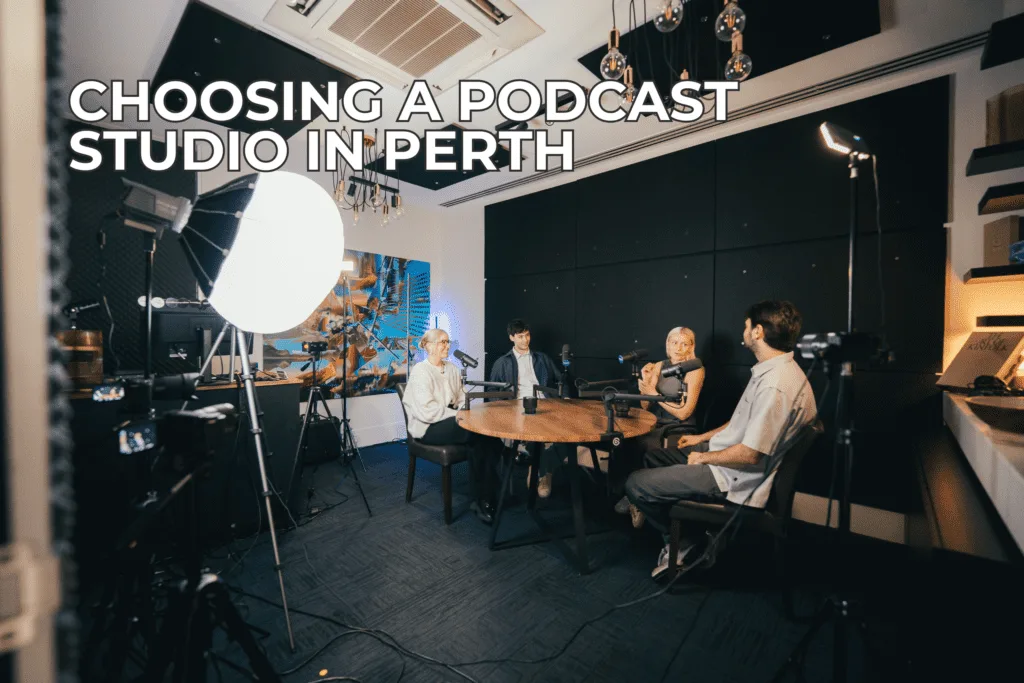

Most Perth business owners book a studio like they’d book a meeting room. They check the location, book a time, record, and then wonder why it sounds rough.
That’s not how this works. The difference between a basic recording space and a purpose-built podcast studio is the difference between a rough demo and a professional product. Before you commit, you need to know what actually matters.
Acoustic Treatment First
A proper podcast studio in Perth has real acoustic treatment. Not foam panels slapped on walls—actual design. The room should minimise reflections, echo, and external noise.
A treated room sounds different. Your voice is present, not tinny. Mouth clicks are reduced. Traffic and HVAC hum are absorbed, not recorded.
When you visit a studio, spend time in the booth alone. Clap your hands. Say a sentence. Does it sound dead and controlled, or does it echo? Can you hear traffic outside? A “dead” room is right. A “live” room is wrong.
Bad acoustic treatment haunts you. Your first five episodes sound thin and amateurish. An engineer can’t fix room reflections in post-production. Good treatment is non-negotiable. It’s the foundation of everything else.
Broadcast-Grade Equipment
Professional equipment costs real money. Broadcast microphones (Shure, Neumann, Rode) run $800–$2,000. Quality interfaces (Focusrite, RME) add another $1,000–$3,000. A properly equipped studio represents $30,000–$60,000 in gear investment.
This matters because cheap equipment has artifacts. You get a slightly compressed, processed sound that fatigues listeners. Professional gear captures clean audio that sounds professional without sounding “processed.”
Ask a studio what microphones they use. If they won’t say, that’s a warning sign. The best studios are proud of their gear. Ask about condenser mics (indoor recording) and dynamic mics (room noise reduction). Ask about preamps and outboard gear.
The signal chain is: mic â preamp â interface â monitoring. A studio that invests in quality at every stage produces noticeably better results than one that cut corners.
Location Matters More Than You Think
Where’s the studio? Central location (West Perth, West Leederville) matters for consistency. A 15-minute drive? You keep appointments. A 45-minute commute across town? You cancel when busy.
Also consider your guests. A guest sitting in traffic for 30 minutes arrives stressed and tired. A guest parking and walking upstairs arrives energised. Location affects episode quality directly.
What Happens After Recording?
Recording is half the job. What’s the studio’s post-production? Does it include:
- Editing and mixing (cleaning audio, balancing levels, intro/outro)?
- Show notes and transcripts (summaries, timestamps, linked resources)?
- Clip extraction (short-form for social)?
- Distribution to all platforms (Spotify, Apple, YouTube)?
Many Perth studios offer recording only. Some offer editing but not show notes. The best offer end-to-end production on a predictable timeline.
Turnaround matters. If you need your episode published by Wednesday, you need a studio that delivers. Most should publish within five business days. Seven to ten days? Their workflow is slow or you’re queued behind others.
Ask upfront: Is turnaround guaranteed? What if you need faster? What’s rush delivery cost?
Team Stability
Who’s actually engineering your sessions? If it’s a different person every time, you lose consistency. A good engineer learns your voice, your mic technique, your preferences. They remember you like a tighter mix or prefer a specific intro sound.
Ask if the studio has a primary engineer or rotating staff. Smaller studios with consistent engineers produce better results because the team learns your show.
Also ask about track record. How many shows have they produced? Can they share examples? Do clients stay long-term or churn? If they can’t point you to established shows they’ve produced, that matters.
Can They Scale With You?
Your podcast will evolve. You’ll add guests, maybe video, maybe change format or frequency. A good studio adapts.
Ask: If I start solo and add a co-host, can you handle two mics? If I want video, do you have lighting and cameras? If I scale from weekly to twice-weekly, can you adjust timeline?
Your Checklist
When evaluating a podcast studio in Perth:
- Acoustic treatment—can you hear room reflections?
- Microphones and interface specs?
- Central location?
- Post-production included (editing, show notes, clips, distribution)?
- Guaranteed turnaround time?
- Primary consistent engineer?
- Examples of their work?
- Flexible for format/scale changes?
The answers reveal whether you’re working with professionals or just renting a room with a mic.
The Investment
Podcast studio hire in Perth is an investment. You want professionals who understand the craft and have systems to deliver consistent results. The best studios compete on quality and turnaround time, not price. If two studios quote wildly different rates, the cheaper one is cutting corners somewhere.
Ready to Choose?
Podwave Studios in West Perth and West Leederville is built specifically for podcasts. Purpose-built recording spaces with full acoustic treatment, broadcast-grade equipment (Shure, Neumann, Focusrite, Rode), and in-house production handling recording, editing, mixing, show notes, short-form clips, and distribution. Most episodes publish within five business days. Visit podwavestudios.com.au to tour and discuss your podcast.